Friday, August 30, 2024

The Origins of Labor Day:A Celebration of Workers and Their Contributions


Labor Day started, like most important American traditions, with people being very tired and finally saying, “Yeah… no.”

Back in the 1800s, the average workday was less “career” and more “survival obstacle course.” People worked long hours in factories that looked like they were designed by someone who hated fingers. Breaks were basically, “Try not to pass out near the machinery.”

At some point, a group of workers collectively looked at each other and realized, “If we all stop at once, they can’t fire… everyone.” That’s when the first real Labor Day energy showed up.

Imagine it: a bunch of exhausted workers marching through the streets, not with polished speeches, but with the vibe of “We would like to sit down. For five minutes. Maybe forever.”

Someone brought a sign that said “Fair Wages.” Someone else brought a sandwich because priorities matter.

The early parades weren’t neat and tidy. They were part protest, part block party, part “I haven’t slept in three days but I feel alive.” There were speeches, music, and probably one guy who thought it was a great time to show off his juggling skills for no reason.

Meanwhile, factory owners watched this and had two thoughts:

  1. “This seems serious.”

  2. “Why is that man juggling?”

Eventually, the idea caught on: maybe workers shouldn’t feel like they’ve been hit by a train every single day. Bold concept.

Labor Day became official after enough people agreed that nonstop grinding wasn’t a personality trait—it was a problem. So the government stepped in and said, “Fine. You get a day.”

Just one. Let’s not get crazy.

And now, Labor Day has evolved into the most ironic holiday of all time. It’s meant to celebrate workers, so naturally, people celebrate by… not working.

You’ve got barbecues, road trips, and someone confidently saying, “I grilled this,” while holding tongs like they just completed a construction project.

Retail workers, of course, are still working, watching everyone else celebrate Labor Day by buying discounted patio furniture at 7 a.m.

“Happy Labor Day,” they say, scanning items with the thousand-yard stare of someone who understands the joke.

But underneath the burgers and long weekends, the holiday still carries that original spirit: a bunch of tired people who decided they deserved better and made enough noise that the world had to listen.

Also, somewhere in the distance, there’s still a guy juggling. No one knows why. He just shows up every year.


Thursday, August 29, 2024

The Art of Landscaping: Balancing the Perfect Combo of Plants and Trees for Your Home


Landscaping is the only hobby where you willingly go outside, stare at a perfectly innocent patch of land, and think, “You know what this needs? A complete personality overhaul.”

It starts with confidence. You step into your yard like a general surveying a battlefield—except the enemy is grass that refuses to grow where you want it and thrives where you don’t. The terrain itself has opinions. Flat? Not on your watch. You create slopes, edges, levels—basically turning your yard into a miniature golf course without the windmill, though give it time.

Then come the trees. Trees are the long-term commitment of landscaping. You plant one thinking, “This will look nice.” Fast forward ten years and it’s blocking the sun, dropping leaves like it’s protesting something, and growing roots that are actively trying to infiltrate your plumbing like tiny wooden spies. But you can’t get rid of it now—it’s family.

Bushes, on the other hand, are the haircut you regret immediately. You trim them once and suddenly you’re in a lifelong contract. Miss one week and they expand like they’ve been hitting the gym in secret. Trim too much and now you’ve got a sad green cube sitting there like it lost its purpose in life. Somehow every bush ends up looking like either a geometry project or a mistake.

And flowers—flowers are the drama department of landscaping. They’re beautiful, delicate, and completely unreasonable. Too much sun? Dead. Not enough sun? Also dead. Too much water? Dead with flair. Not enough water? Dead, but quietly judging you. You plant them for color and end up with a daily emotional rollercoaster. One day they’re thriving, the next they look like they’ve read the news.

Mulch gets thrown in like the finishing touch, as if sprinkling brown wood chips everywhere is the landscaping equivalent of saying, “Nailed it.” Nothing says “I have control over nature” like aggressively placing mulch around things you’re hoping survive.

And yet, despite the chaos, the sweat, and the quiet resentment from your own yard, you step back when it’s done and admire it like a masterpiece. Because landscaping isn’t about perfection—it’s about convincing yourself that this very specific arrangement of dirt, plants, and mild frustration was all part of the plan.

Until next season, when the yard decides it has notes.

Tuesday, August 27, 2024

Understanding the Wild Whirlwind: The Weather Patterns Behind Tornadoes


Tornadoes don’t arrive. They make an entrance like they just kicked open the door of reality and yelled, “Who rearranged my air?!”

I learned this the hard way, standing in my kitchen holding a bag of chips like it was a life decision. The sky outside turned that weird green color that looks like nature accidentally hit the wrong filter. The trees stopped politely swaying and started doing full-body panic. Even the neighbor’s lawn gnome looked nervous—and that guy has seen things.

The weather alert went off with that dramatic “this is not a drill” tone, and suddenly I became an expert in bad decisions. Do I go to the basement? Do I grab supplies? Do I… keep eating chips because stress calories don’t count? Meanwhile, the wind outside sounded like a vacuum cleaner that just sucked up a motorcycle.

Then it hit nearby. Not on me, thankfully—but close enough that everything turned into slapstick chaos. My trash can? Gone. Not tipped over—gone. Like it got promoted to the sky. Patio furniture started sliding across the yard like it was late for work. A folding chair did a full Olympic routine—spin, flip, emotional exit.

I looked out the window just in time to see my neighbor sprinting after a plastic kiddie pool like it owed him money. The pool, to its credit, was winning.

Inside, I tried to stay calm. “Be prepared,” they say. So I grabbed a flashlight, a blanket, and—naturally—a random screwdriver. Why? No idea. In my mind I was thinking, “If this tornado needs tightening, I’m ready.”

Down in the basement, everything suddenly felt very quiet, which is somehow worse. You’re just sitting there listening to the house creak like it’s telling ghost stories. Every sound feels personal. A thud upstairs? That’s not just a thud—that’s your roof reconsidering its life choices.

When it finally passed, I came upstairs expecting total devastation. Instead, it looked like my yard had hosted a very aggressive yard sale. My grill had moved three feet like it needed space. A tree branch was sitting in the driveway like it was waiting for a ride. And somehow, out of everything, my one ugly lawn ornament survived untouched—clearly the tornado took one look and said, “No, that’s already been through enough.”

The wildest part? Five minutes later, the sun comes out like nothing happened. Birds start chirping again like they didn’t just witness airborne patio furniture. And there I am, standing in the yard holding that same bag of chips, wondering if I just survived a natural disaster or participated in the world’s most chaotic comedy sketch.

Tornadoes aren’t just storms. They’re nature’s way of reminding you that no matter how organized you think your life is, it can still pick up your stuff, spin it around, and redecorate without asking.

And honestly? I’m still looking for that trash can. I think it’s living a better life now.

Friday, August 23, 2024

The Ramifications of Price Control: A Double-Edged Sword


Price control sounds great in theory. It’s the kind of idea that shows up looking like a superhero—cape flowing, dramatic music, promising to save your wallet from evil prices. And for about five minutes, everyone claps.

Then reality shows up wearing sweatpants and eating cereal out of the box.

I imagine price control like someone walking into a bakery and saying, “Alright everyone, cupcakes are now $1. No exceptions.” Customers cheer. Bakers blink. Somewhere in the back, a cupcake quietly packs its bags and leaves.

At first, it feels like winning. “Look at these cheap prices!” you say, proudly holding your $1 cupcake. But the next day, there are fewer cupcakes. By day three, the cupcakes are smaller. By day five, it’s just a guy behind the counter shrugging at an empty shelf like, “We have… crumbs?”

Because here’s the trick: when you tell prices they can’t go up, supply hears that and says, “Cool, I’ll go down then.” It’s like a seesaw where one side refuses to move, so the other just gives up entirely.

Meanwhile, big companies—oh, they don’t panic. They adjust. They’ve got spreadsheets, lawyers, backup plans, backup backup plans, and a guy named Greg whose entire job is to “navigate situations.” Greg loves price controls. Greg thrives in chaos. Greg has three monitors and zero fear.

Small businesses, though? They’re in the corner doing math like it’s a horror movie. “If I sell this for that… and my costs are this… then I… disappear?” Suddenly, the local shop that made everything personal is gone, and you’re left with giant corporations who can afford to play the long game.

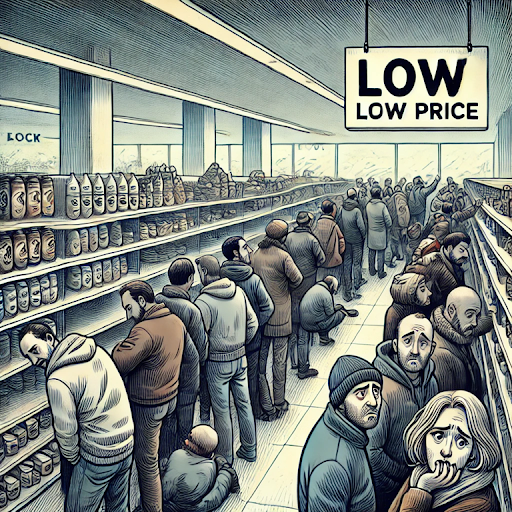
It turns into a weird slapstick routine. Shelves get emptier. Lines get longer. People start hoarding like it’s an Olympic sport. You go in for milk and leave with a life lesson and maybe a single yogurt if you’re lucky.

And somehow, the big companies are still there. Not just surviving—thriving. They’ve streamlined, optimized, and probably renamed the yogurt “Dairy Experience™” while selling it in packs of six you didn’t ask for.

Price control was supposed to make everything fair. Instead, it’s like trying to fix a leaky pipe with duct tape… and then being surprised when the water finds a new way to spray directly into your face.

In the end, you’re standing there, holding your one discounted item, staring at a half-empty store, wondering how something designed to make life cheaper somehow made everything harder to get.

And Greg? Greg just got a promotion.

Thursday, August 22, 2024

The Art of Government Gaslighting: How Reality Is Up for Debate


Government gaslighting is like being in a group project where one person does all the talking, none of the listening, and then insists you’re the one who misunderstood the assignment.

It starts small. You notice something off—prices, policies, promises doing gymnastics. You say, “Hey… this feels weird.” And the response comes back smooth as butter: “We hear you. Nothing is weird. In fact, things have never been more not weird.” Suddenly you’re standing there questioning your own eyeballs like they just betrayed you.

It’s the classic move: reality happens, then someone steps up to explain that reality didn’t actually happen the way you experienced it. You’re told things are improving while your grocery receipt looks like it just ran a marathon. “What you’re seeing isn’t what you think you’re seeing,” they say, like your wallet is just being dramatic for attention.

The wild part is how coordinated it feels. Different voices, same message. It’s like they all went to the same seminar called Advanced Pretending 101: How to Smile While Rewriting Reality. You start hearing phrases repeated so often they sound like a chorus. Meanwhile, you’re just trying to remember when common sense became optional.

And the people? They react in stages. First comes confusion. Then frustration. Then that quiet moment where you laugh because if you don’t, you’ll end up arguing with your toaster for validation. Conversations start sounding like:
“Is it just me?”
“No, I thought the same thing.”
“Okay good, I was about to apologize to my own thoughts.”

Trust starts slipping—not dramatically, but like socks on a hardwood floor. Slow, steady, and suddenly you’re on the ground wondering how you got there. When the people you’re supposed to rely on keep telling you everything’s fine while things feel… not fine, it creates this weird disconnect where reality and messaging are basically not on speaking terms.

And here’s the twist: the more it happens, the less people argue about the issue itself and the more they argue about what’s real. Now everyone’s debating definitions, interpretations, tone—anything except the actual problem. It’s like a magic trick where the distraction becomes the main event.

In the end, it doesn’t just confuse people—it wears them out. Because nothing is more exhausting than being told you’re wrong about something you’re literally living through. You don’t feel represented; you feel like you’re in a never-ending episode of “Are We Sure About That?”

And somewhere in the background, the messaging keeps rolling, calm and confident, like a GPS that refuses to admit it’s rerouting you into a lake.

“Continue straight,” it says.

You look at the water.

It says, “This is fine.”

Saturday, August 17, 2024

The Invention of Zip Ties: A Simple Solution to a Complex Problem


The first zip tie was not invented. It escaped.

Somewhere in the late 1950s, inside a factory that smelled like burnt coffee and bad decisions, an engineer was staring at a pile of wires that looked like spaghetti after a bar fight. His boss walked in, stepped on a cable, tripped, and invented new curse words not yet recognized by science.

“Fix this,” the boss said, pointing at the chaos like it personally insulted his family.

So the engineer did what all great minds do under pressure—he stared at it until his soul left his body for a few minutes. Then, in a moment of accidental genius, he created a tiny plastic strip with teeth. A polite little snake that only bites once.

And thus, the zip tie was born… or more accurately, unleashed.

At first, it was innocent. It helped organize wires. It made things neat. It whispered, “I bring order.” People trusted it. That was their first mistake.

Because once you hear that click-click-click, it’s over. There’s no undo. No “oops.” No second chances. Zip ties don’t believe in forgiveness. You tighten it too much? Congratulations—you’ve just permanently married those objects.

Engineers loved it. Electricians worshipped it. Somewhere, duct tape felt threatened.

But then the zip tie started branching out.

Police said, “Hey, this is handy.”
DIY people said, “I can fix anything with 37 of these.”
Gardeners said, “Plants? Controlled.”
Someone looked at a broken car bumper and said, “You’re staying right there, buddy,” and zip tied it like it owed them money.

Suddenly, zip ties were everywhere. Holding fences together. Fixing lawn chairs. Acting as emergency belt replacements for people who made questionable buffet decisions.

And then came the dark side.

You ever try to undo a zip tie without scissors? That’s not a task. That’s a personality test. You’re either calm and resourceful… or you’re gnawing at plastic like a raccoon that made poor life choices.

Some people claim there’s a trick to releasing them. Those people are either lying or part of a secret society.

Meanwhile, zip ties are just sitting there like, “You did this. Not me.”

They don’t stretch. They don’t negotiate. They don’t care about your plans. You tighten it, and it commits harder than someone who just signed a 30-year mortgage after a motivational podcast.

And the worst part? You always use one more than you need.

You start with a simple project: “I’ll just organize these cables.”
Twenty minutes later, you’ve zip tied things that didn’t need tying. A chair leg. A random stick. Somehow, your own hoodie string.

You sit back, look at your work, and think, “This is permanent now.”

That’s the real legacy of the zip tie. Not organization. Not convenience.

Commitment.

Cold, unbreakable, plastic commitment.

The Reality of Gas Exploration

  Gas exploration is often portrayed as a simple process of drilling and striking energy, but the reality is far more technical, expensive, ...