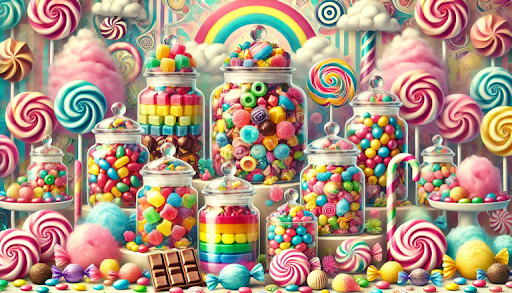
Candy was clearly invented by a child who somehow got access to a lab and zero adult supervision.
Think about it. No reasonable adult wakes up and says, “You know what the world needs? Edible neon ropes that taste like happiness and chaos.” That’s a kid idea. Probably pitched mid-sugar rush: “What if… snacks… but louder?”
Candy doesn’t just exist—it performs.
You open a bag and suddenly you’re holding a rainbow that legally shouldn’t be that shiny. Gummies bounce. Chocolate melts like it’s emotionally overwhelmed. Hard candy sits there like, “Go ahead. Break a tooth. I dare you.”
And kids? Kids don’t eat candy. They experience it.
A child with a lollipop isn’t just having a treat—they’re conducting a full scientific study:
How long can this last?
What happens if I lick it sideways?
What if I stick it to the table for five minutes?
Meanwhile, parents are watching like wildlife observers. “Notice how the child becomes 87% louder after three bites…”
Chocolate is the smooth talker of the candy world. It shows up calm, collected, acting like it has a 401(k). Then five minutes later it’s melted into your hand like, “I never said I had stability.”
Gummies are chaos in small, friendly shapes. Bears, worms, fruit slices—none of these things should be chewy, yet here we are. You bite one and it fights back just enough to feel personal.
Sour candy? That’s just betrayal coated in sugar. Kids pop one in like heroes, then immediately make a face that looks like they just bit into a lemon that owes them money.
And don’t even get started on candy corn. That’s not candy—that’s a seasonal debate.
The real magic of candy isn’t just the taste. It’s the transformation.
A quiet kid becomes a stand-up comedian.
A tired kid becomes a track star.
A calm kid becomes… suspiciously quiet, which is somehow worse.
And then comes the aftermath.
Wrappers everywhere. Sticky fingerprints on surfaces that were once clean. A mysterious half-eaten gummy found three days later in a place no gummy should ever be.
Yet somehow, candy survives every generation.
Because it’s not just sugar—it’s a tiny, colorful moment of joy. A reward. A celebration. A “yes, you can have one more” that turns into “okay, maybe two more, but that’s it… okay three, but we’re done.”
Candy doesn’t pretend to be healthy. It doesn’t offer life advice. It just shows up, tastes amazing, and leaves everyone slightly more chaotic than before.
Honestly, that’s a pretty solid legacy.