Wednesday, June 19, 2024

Discovering Mendenhall Glacier: A Journey into Alaska’s Frozen Wonderland


Rafting near the Mendenhall Glacier is the kind of experience that makes you feel like you accidentally signed up to be the main character in an adventure movie… except your role is “guy trying not to scream too loudly in front of strangers.”

It starts calmly. Too calmly.

You’re standing there, geared up in what can only be described as a fashionable marshmallow suit, holding a paddle like you’ve known what you’re doing your whole life. The guide gives instructions—important, probably life-saving instructions—and everyone nods like, “Yes, of course, paddling makes sense.” Meanwhile, I’m still figuring out which end of the paddle is the business end.

Then you see it—the glacier.

It’s massive. It’s glowing blue like it’s powered by secrets. It looks like something that’s been sitting there for thousands of years just waiting for you to float by so it can go, “Watch this.” And suddenly, you feel honored. And tiny. And slightly like a snack.

You get into the raft, and for a brief moment, everything is peaceful. The water is smooth, the air is crisp, and you think, “Wow, this is serene.”

Then the river politely says, “Alright, let’s add some spice.”

The raft hits the first bit of movement, and everyone instantly becomes a team. A very enthusiastic, slightly uncoordinated team. The guide is shouting commands like a drill sergeant with a sense of humor—“Paddle forward!”—and we’re all paddling like we’re auditioning for a survival show.

Water splashes up. It’s cold. Not “refreshing dip” cold. This is “I just discovered new layers of my soul” cold. You laugh, because what else are you going to do? Crying would freeze mid-air.

And the best part? You’re surrounded by ridiculous beauty the entire time.

Snow-dusted peaks. Forests so green they look fake. Ice floating by like nature’s version of luxury yachts. At one point, I was paddling, laughing, slightly soaked, and thinking, “This is either the best idea I’ve ever had or the most scenic mistake of my life.”

Either way, worth it.

There’s a moment during the raft where everything just clicks. The paddling gets smoother, the team starts to sync up, and you realize—you’re actually doing it. You’re navigating icy water next to a glacier like some kind of rugged explorer… who may or may not have yelled “WHOA” a little too loudly five minutes ago.

By the end, you’re soaked, energized, and grinning like you just got away with something.

Because you kind of did.

You floated next to an ancient glacier. You laughed in the face of freezing water. You paddled like a champion (or at least like someone trying very hard). And somehow, you came out of it feeling like you leveled up as a human being.

Would I do it again?

Absolutely.

Next time, I’m bringing two things: better paddle confidence… and a victory speech for when I inevitably declare myself “King of the Glacier” halfway through.

Saturday, June 15, 2024

The Wild Wild West: Hardships and Luxuries


The Wild West was basically a group chat with no moderator, no rules, and everyone had a mustache that looked like it made its own decisions.

Back then, if someone cut you off in traffic, there was no traffic—just a guy named Earl on a horse judging you silently while chewing something that might’ve been tobacco or drywall. Today, you get honked at and flip someone off. Back then, you got stared at, and suddenly there was a piano playing somewhere and you were legally required to duel at noon.

Saloon doors didn’t just open—they announced problems. You couldn’t casually walk into a bar. You had to burst in like you were either here to drink whiskey or ruin someone’s entire bloodline. Meanwhile today, we push open a glass door while checking our phones and apologizing to a plant.

Ordering a drink in the Wild West was simple:
“Whiskey.”
That’s it. No flavors, no options, no “Can I get that with oat milk?” You got a brown liquid that tasted like regret and poor decisions, and you liked it because the alternative was dehydration and becoming part of the scenery.

Law enforcement was one guy. Just one. A sheriff with a badge, a hat, and the emotional exhaustion of someone who knows Gary is about to start something again. Today we have entire departments, paperwork, policies. Back then the policy was, “Gary, don’t.” And Gary absolutely did.

Healthcare? You got a guy with a bag. Not even a good bag. Just a bag that looked like it had seen things. If you got shot, the treatment plan was basically, “Let’s see what happens.” Now we have hospitals, insurance, and bills that make you wish you’d just gone back to the bag guy.

Fashion was aggressive. Everyone dressed like they were about to either rob a train or write a country album. Boots, hats, spurs—spurs! Imagine going to the grocery store today and hearing someone jingle behind you like a festive threat.

Communication was slow and dramatic. You wanted to send a message? You wrote it down, handed it to a guy, and hoped he didn’t get distracted by a cactus or existential dread. Today, we send texts and still get mad if someone takes five minutes to respond. In the Wild West, five minutes meant your messenger hadn’t even emotionally prepared to leave yet.

And let’s talk about conflict resolution. Today, you argue online with strangers named things like “TruckGuy92.” Back then, you argued with eye contact, sunlight, and a countdown to potential death. There was no “typing…” bubble. Just tension and a lot of squinting.

Honestly, the Wild West wasn’t tougher people—it was just fewer options. You couldn’t order food, call for help, or Google “how to survive a snake bite.” You just looked at the snake and both of you made choices.

Now we’ve got comfort, convenience, and chairs that don’t try to collapse under us for character development. But a small part of me wonders… if someone burst through a set of saloon doors today, would we instinctively duck… or just assume it’s a themed restaurant and ask for the drink menu?

Probably both.

The Art of Whiskey Making: From Grass to Glass


I decided to learn the art of making whiskey for the same reason most bad ideas begin: confidence and a complete lack of understanding.

In my head, I pictured myself as a rugged craftsman—half pioneer, half legend—standing over a barrel, nodding slowly while something aged into greatness. In reality, I was in my kitchen Googling, “Can this explode?” while stirring something that looked like oatmeal with commitment issues.

Whiskey making starts with grain, water, and yeast. Simple, right? That’s what I thought—until I realized yeast is basically a tiny army that eats sugar and burps alcohol. So now I’m standing there, watching bubbles rise like I’ve created some kind of microscopic frat party, wondering if I should be proud or concerned.

Then comes fermentation, which is a fancy word for “wait and hope nothing smells like regret.” Spoiler: it does. There’s a phase where your house smells like bread had a midlife crisis and decided to become a scientist. You keep telling yourself, “This is normal,” while cracking a window and apologizing to your neighbors with your eyes.

Distillation is where things get serious—or at least feel serious. This is the part where people who know what they’re doing nod a lot and use words like “cuts” and “proof.” I nodded too, mostly because I had no idea what was happening and didn’t want the equipment to sense fear.

You’re separating liquids based on boiling points, which sounds impressive until you realize you’re basically babysitting a hot, angry kettle that demands constant attention. One wrong move and you’re not making whiskey anymore—you’re starring in a cautionary tale.

And then there’s aging. This is where whiskey becomes whiskey and not just “that thing I made that one time.” You pour it into a barrel and wait. And wait. And wait some more. It’s the only hobby where progress looks like absolutely nothing happening. I checked on mine daily like it was going to wave back at me.

At one point, I stared at the barrel and said, “Do something.” It did not.

What they don’t tell you is that making whiskey is less about action and more about patience and resisting the urge to mess with it. It’s like raising a teenager—if you poke it too much, it turns out weird and nobody wants to talk about it.

Finally, the day comes. You pour a glass, hold it up to the light like you suddenly understand sunsets, and take a sip.

And you know what? It’s… actually good. Not “quit your job” good, but definitely “I won’t apologize for this” good. There’s a warmth to it, a little bite, and just enough smoothness to make you forget the part where your kitchen smelled like a science experiment gone rogue.

Making whiskey taught me a few things: patience is real, yeast is chaotic, and anything worth bragging about probably started with a questionable decision.

Also, if you ever visit my house and I offer you a drink, just know—you’re either about to experience handcrafted excellence… or become part of the story.

Friday, June 14, 2024

The Science Behind Noise Canceling Headphones


I didn’t buy noise-canceling headphones for peace. I bought them because my neighbor owns what I can only assume is a jet engine disguised as a leaf blower and a personality.

The first time I put them on, I expected silence. Not real silence—more like “library with a mild judgmental librarian” silence. What I got instead was something closer to emotional anesthesia. I pressed the button, and suddenly the world didn’t just quiet down… it politely excused itself.

There’s actual science behind this magic trick. Tiny microphones on the outside of the headphones listen to the chaos of the universe—dogs barking, engines revving, someone loudly explaining cryptocurrency at a coffee shop—and then the headphones generate an opposite sound wave. It’s like noise walks in the door, and the headphones go, “Oh no you don’t,” and cancel its existence like a bouncer with a physics degree.

This is called active noise cancellation, but I prefer to think of it as selective reality editing.

The weird part? Your brain gets involved. Once the background noise disappears, your brain—normally busy dodging auditory nonsense—finally relaxes. It’s like a security guard who’s been chasing raccoons all night suddenly gets a vacation. That’s where the comfort comes from. Not just physical comfort from the cushy ear cups, but cognitive comfort. Your mind unclenches.

I noticed it immediately. I was sitting there, wearing my headphones, doing absolutely nothing, and yet it felt productive. My thoughts weren’t being interrupted by random sonic jump scares. For once, my brain wasn’t buffering like a bad Wi-Fi connection.

And then something unexpected happened: I became emotionally attached to them.

I don’t mean in a normal “these are nice headphones” way. I mean in a “where are they, who moved them, I cannot face the world without them” way. They became my portable bubble. My force field against humanity’s greatest hits album: coughing, chewing, loud phone calls that start with “I’m on speaker,” and that one guy who treats silence like a personal enemy.

There’s also a strange side effect. When you take them off, reality comes back like it’s been waiting behind the curtain the whole time. The noise doesn’t ease in—it kicks the door open. Suddenly you hear everything. The fridge hum. The clock ticking like it’s judging your life choices. Your own breathing, which somehow sounds louder and more suspicious than before.

It’s like your ears went on vacation and came back with heightened expectations.

But the real comfort science isn’t just the sound waves canceling each other out. It’s control. You don’t get to control much in life—traffic, weather, that one coworker who microwaves fish—but you can control what reaches your ears. And that’s powerful in a quiet, slightly smug way.

So now I wear them everywhere. Not always playing music. Sometimes just sitting in the sweet, engineered absence of nonsense. It’s not silence. It’s curated existence.

And if you see me out in public, wearing them with nothing playing, just nodding like I’m in on some secret… I am.

The secret is: the world is loud, and I have a button that tells it to calm down.

Thursday, June 13, 2024

The 1947 Willy’s Jeep: A Symbol of Military Innovation


I didn’t choose the Jeep Willys. It chose me—like a muddy, loud, slightly judgmental time machine that still thinks it’s on active duty.

The first thing you notice is that it doesn’t start so much as it accepts orders. You turn the key, it coughs, pauses like it’s waiting for a commanding officer, and then decides whether your rank is high enough to justify ignition. Some mornings, I’m pretty sure it demotes me.

Driving it feels less like commuting and more like being deployed to aisle seven at the grocery store. No doors worth mentioning. No roof that inspires confidence. Just you, the wind, and the constant feeling that you should be carrying a map and a very important message instead of a list that says “milk, eggs, regret.”

There’s history baked into every rattle. This thing was built for the chaos of World War II—mud, sand, questionable roads, and even more questionable decisions. Meanwhile, I’m over here hesitating at a yellow light like it’s a life-altering choice. The Willys has seen worse. It judges me quietly.

The ride itself? Let’s just say suspension was more of a suggestion back then. Every bump feels like basic training for your spine. You don’t sit in a Willys—you brace. Potholes aren’t inconveniences; they’re surprise drills. Somewhere, a drill sergeant is nodding approvingly.

And the steering wheel? It doesn’t turn so much as it requires commitment. You don’t casually drift into a parking spot—you execute a maneuver. Parallel parking feels like a tactical operation that may require backup and a snack break.

But here’s where it gets weirdly emotional.

When you’re driving it, you can’t help but think about the people who drove these things when it actually mattered—when the destination wasn’t “home before dinner” but something a lot heavier. It adds this quiet respect underneath all the rattling chaos. Like, yeah, I’m just heading to grab snacks, but this little machine once carried far bigger stakes.

Also, people treat you differently. You don’t just get waves—you get acknowledgment. Veterans give you that look like, “Yeah, I know what that is.” Kids think you’re in a movie. One guy gave me a thumbs-up so serious I felt like I had just completed a mission, even though I was literally idling at a stop sign.

And the best part? There’s no insulation from the world. Modern cars wrap you in comfort and pretend nothing exists outside your playlist. The Willys throws you straight into the elements like, “Congratulations, soldier, you’re part of the environment now.” Wind, noise, random smells—you experience it all like it’s part of the briefing.

Would I daily drive it in the middle of winter? That’s not bravery—that’s poor decision-making with patriotic undertones.

Would I take it out just to feel a little tougher, a little more connected to something bigger than my daily routine? Every time.

Because the Jeep Willys doesn’t care about comfort, convenience, or your heated seats. It cares about moving forward, making noise, and reminding you—very loudly—that not everything built to last was built to be easy.

Now if you’ll excuse me, I have a highly classified mission.

It involves snacks.

The Science of Attraction: What Really Draws Us In?


I used to think attraction was simple. You see someone, your brain plays a little highlight reel, and boom—feelings. Turns out, it’s less “romantic movie” and more “chemical group project where nobody communicates.”

Attraction, scientifically speaking, is your brain running a background app called What If We Ruined Our Life Real Quick. It starts with dopamine—that sneaky little reward chemical that lights up when you eat pizza or win an argument in your head three hours later. Suddenly, this person walks by and your brain goes, “Yes. More of that. Whatever that is.”

Then comes norepinephrine, which is basically adrenaline in a tuxedo. Your heart starts beating like you just ran up a flight of stairs for no reason. You forget basic words. You try to say something cool and end up sounding like a confused GPS recalculating mid-sentence.

And let’s not forget serotonin, which politely exits the building. That’s why you start thinking about this person constantly. You’re not “in love”—your brain just misplaced its ability to focus on literally anything else. I once stared at a wall for ten minutes because someone smiled at me earlier. A wall. It wasn’t even a good wall.

On a personal level, my body handles attraction like it’s never done this before. There’s no smooth transition. It’s all or nothing. One minute I’m calm, collected, a model of human stability. Next minute, I’m overanalyzing a “hey” text like it’s a coded message from a spy movie.

“Hey.”
What does that mean? Casual? Enthusiastic? Emotionally distant but open to snacks? I need data.

Science also says we’re drawn to things like symmetry, scent, and voice. Apparently, your brain is out here conducting a full audit without telling you. Meanwhile, I’m just thinking, “They seem nice and didn’t immediately run away when I spoke,” which feels like a strong foundation.

Then there’s pheromones—the invisible, mysterious signals your body sends out like, “Hello, I am biologically interesting.” You can’t see them, you can’t hear them, but they’re apparently doing a lot of heavy lifting. Meanwhile, I’m over here trying to contribute by wearing a decent shirt and remembering how to form sentences.

The real twist is how unpredictable it all is. You can’t schedule attraction. You can’t reason with it. Your brain just flips a switch at the worst possible time. Grocery store? Sure. Middle of a conversation where you were doing fine five seconds ago? Absolutely.

And once it starts, your logic takes a backseat. Red flags? Your brain calls them “fun little decorations.” Awkward moments? “Charming quirks.” Suddenly, you’re out here defending behavior you would normally avoid like expired milk.

But underneath all the chaos, there’s something kind of fascinating about it. Your brain, your body, your instincts—they’re all trying to sync up and say, “Hey, this person matters for some reason.” Even if that reason is temporarily sponsored by bad decisions and strong coffee.

So now I respect the science of attraction a little more. Not because I understand it—absolutely not—but because I’ve accepted that my brain is running a complicated experiment without my permission.

And honestly?

I’m just hoping for decent results and minimal side effects.

Wednesday, June 12, 2024

Facts and Misconceptions of Speed Dating


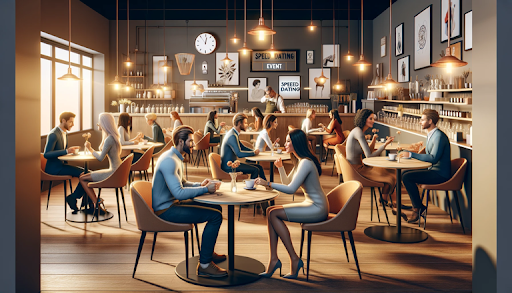
I went to a speed dating event once because I thought it would be efficient. You know—romance, but with a schedule. Love, but make it a dentist appointment.

The first misconception is that it’s “speedy.” That word suggests confidence, precision, maybe even a stopwatch and a whistle. In reality, it’s seven minutes of trying to decide which version of yourself to present: Cool Me, Funny Me, or Please-Like-Me Me. I cycled through all three in the first 90 seconds and ended up introducing myself twice.

Fact: there is a bell.
Misconception: the bell brings clarity.

The bell is chaos. The bell is judgment. The bell is basically saying, “Time’s up—wrap up whatever personality you were pretending to have.” I once got cut off mid-sentence and had to leave a story hanging like a cliffhanger nobody asked for. Somewhere out there is a person who thinks I might have wrestled a raccoon. I didn’t. But I didn’t get to finish.

Another misconception is that you’ll meet “your type.” What you actually meet is every type. It’s like a sampler platter of humanity. Within one hour, I spoke to a marathon runner, a conspiracy theorist, a guy who owns three ferrets, and someone who asked me what my “five-year emotional roadmap” looked like. Sir, I barely have a five-minute plan right now.

Fact: you learn a lot about yourself.
Misconception: it’s all good.

Turns out, under time pressure, I become a mix of game show contestant and confused intern. My brain starts pulling random facts like it’s grabbing items in a supermarket sweep. “Hi, I’m me, I like coffee, I once fixed a chair, and I have strong opinions about sandwiches.” None of that has ever been part of my identity before.

There’s also this myth that first impressions are everything. That’s technically true, but speed dating turns first impressions into only impressions. There’s no time for a second layer. You’re judged entirely on your opening line and whether you can maintain eye contact without looking like you’re solving a math problem in your head.

And then there’s the note-taking.

You get this little card to mark who you liked, which sounds simple until you realize you’ve met twelve people named some variation of “Chris” and your notes say things like:
“Chris – laughed at joke?”
“Other Chris – strong handshake, maybe too strong?”
“Another Chris – possibly owns reptiles?”

By the end, it looks less like a dating record and more like a detective’s notebook.

But here’s the surprising fact: it’s actually kind of fun.

Not in a smooth, romantic way—but in a “well, that just happened” way. There’s something weirdly refreshing about it. No endless texting. No overthinking a message for three hours. Just face-to-face, rapid-fire human interaction where everyone is equally unsure but pretending otherwise.

You also realize pretty quickly that everyone’s nervous. Even the confident ones have that split-second pause where their brain goes, “Wait, what’s my name again?” It levels the playing field. You’re all just humans trying to make a connection before the bell interrupts like an impatient referee.

Would I say speed dating is the best way to find love? Let’s not get carried away.

But is it a fascinating social experiment where you learn how you come across under pressure, meet a wide range of personalities, and possibly leave with a story about a guy and his three ferrets?

Absolutely.

And honestly, if nothing else, it teaches you one important skill:

How to make seven minutes feel like both a lifetime and no time at all.


The Fourth of July Boating Guide: Sandbars, Sunshine, and People Watching

  There are two kinds of people on the Fourth of July. The ones stuck in traffic wondering why they left the house... and the smart ones alr...